

A shopper searching for a peptide supplier in Australia may find several sites that look local. One quotes prices in Australian dollars, another lists an Australian contact, and a third promises domestic delivery. Those details may make a seller feel familiar, but they don't establish whether a particular product can lawfully be supplied or whether its identity and quality can be checked.
The useful first questions aren't about discounts or persuasive purity claims. They're about the product's intended purpose, its regulatory status and supply pathway, and whether its batch documentation can be traced. You don't need to interpret legislation alone, but you should be able to get clear answers before sharing personal information or placing an order.
Table of Contents
- Why an Australian Supplier Label Is Not Enough
- Understanding Australia's Therapeutic Peptide Rules
- How Personal Import Differs From Commercial Supply
- Comparing Approved Unapproved and Compounded Pathways
- How Bulk Aussie Peptides Can Help
- Checking Supplier Status Labels and Traceability
- Examples of Warning Signs and Safer Choices
- Making a Professional and Safety Decision
- A Safer Rule for Choosing a Peptide Supplier
Why an Australian Supplier Label Is Not Enough
The most polished storefront in the country can still offer an unapproved product. That sounds exaggerated, but it follows directly from how Australian regulation works: the rules attach to the product and its supply pathway, not to the seller's postcode or web design.
Consider two storefronts that both appear to serve Australian customers. One has polished product pages, laboratory-style photographs and a local delivery option. The other looks less impressive but clearly identifies what each product is, explains its regulatory status and provides traceable documentation. The first may make the stronger impression; that doesn't make it the better-evidenced option.
An Australian address tells you something about the seller's stated location. It doesn't, on its own, show that a product is listed on the Australian Register of Therapeutic Goods (ARTG), that its import or supply pathway is lawful, or that its label and batch records are adequate. A confident purity claim works the same way: it isn't a substitute for knowing who made the product, what it contains or how the claim was tested.
The Therapeutic Goods Administration (TGA) warns that many peptides promoted through online channels are unapproved therapeutic goods, and its published guidance sets out how these products are regulated. A seller's choice of wording, such as a “research use only” label, doesn't change how a product is classified or what obligations apply to supplying it.
A local address answers where the seller sits; it never answers what the product is.
A careful check follows a sensible order. Identify what the product is claimed to do, establish which regulatory pathway applies, look at the label and batch evidence, and consider whether a health professional should be involved. That process won't guarantee a product is safe, but it exposes gaps that a local address, a testimonial or a polished website can only paper over.
Understanding Australia's Therapeutic Peptide Rules
The first question is what the product is intended to do. Under the Therapeutic Goods Act 1989, peptide products fall within Australia's therapeutic-goods framework when they're promoted, supplied or intended for therapeutic purposes, such as modifying a physiological process, treating disease or alleviating an ailment. Marketing language matters as evidence of intended use, but a seller can't make regulatory requirements disappear by choosing a different label.
For products regulated as therapeutic goods, ARTG inclusion is generally required before import, manufacture, supply, export or advertising, unless a specific exemption, approval or authority applies. The TGA sets out this framework in its published guidance on therapeutic peptide products, as noted earlier. Australian manufacturers generally also need a manufacturing licence, including when making unapproved goods, unless an exemption applies.
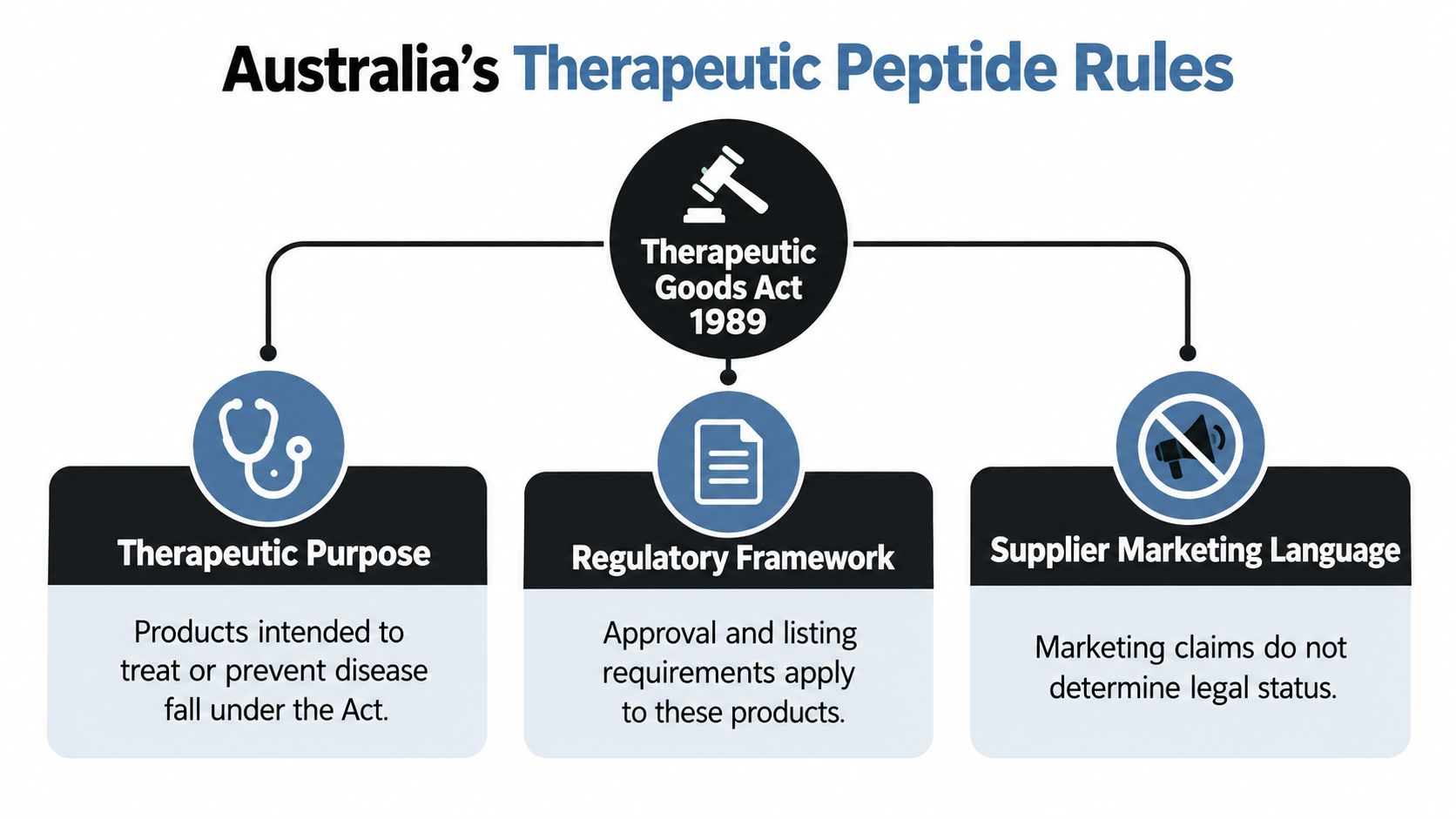
The ARTG is a pathway check, not a location check
An Australian warehouse is the building, but it doesn't tell you whether a particular item belongs on a particular shelf. The product's regulatory status, the authority of the manufacturer or importer, and the intended supply route determine whether it can lawfully move through that pathway.
A supplier's address and a product's status are separate questions. A business may be based in Australia while a product is imported, unapproved or offered through a route that doesn't suit its therapeutic claims. The relevant check is about the exact product and its route, not the general appearance of the business.
If you've weighed up therapeutic products in other categories, this Australian guide to CBD oil and its regulatory context shows the same logic at work elsewhere.
Location, delivery speed and labelling never settle the question. A product can sit in a Melbourne warehouse, ship overnight and carry a professional-looking label while still being unapproved, mislabelled or supplied through a pathway that doesn't fit its claims. Only the product's regulatory status separates lawful supply from everything else a seller might offer.
How Personal Import Differs From Commercial Supply
An individual importing a product for their own use and a business selling to the public are doing different things, and the rules treat them differently. The TGA's guidance on responsibilities for importing, compounding and supplying unapproved peptide products draws this line clearly, with limited access pathways on one side and commercial supply and public advertising on the other.
Under the Personal Importation Scheme, an unapproved therapeutic good may be imported only when all scheme conditions are met. Those conditions include clear and accurate labelling that identifies the therapeutic good. The scheme doesn't permit commercial supply or public advertising of unapproved therapeutic goods, so a seller can't borrow its cover to run a storefront.
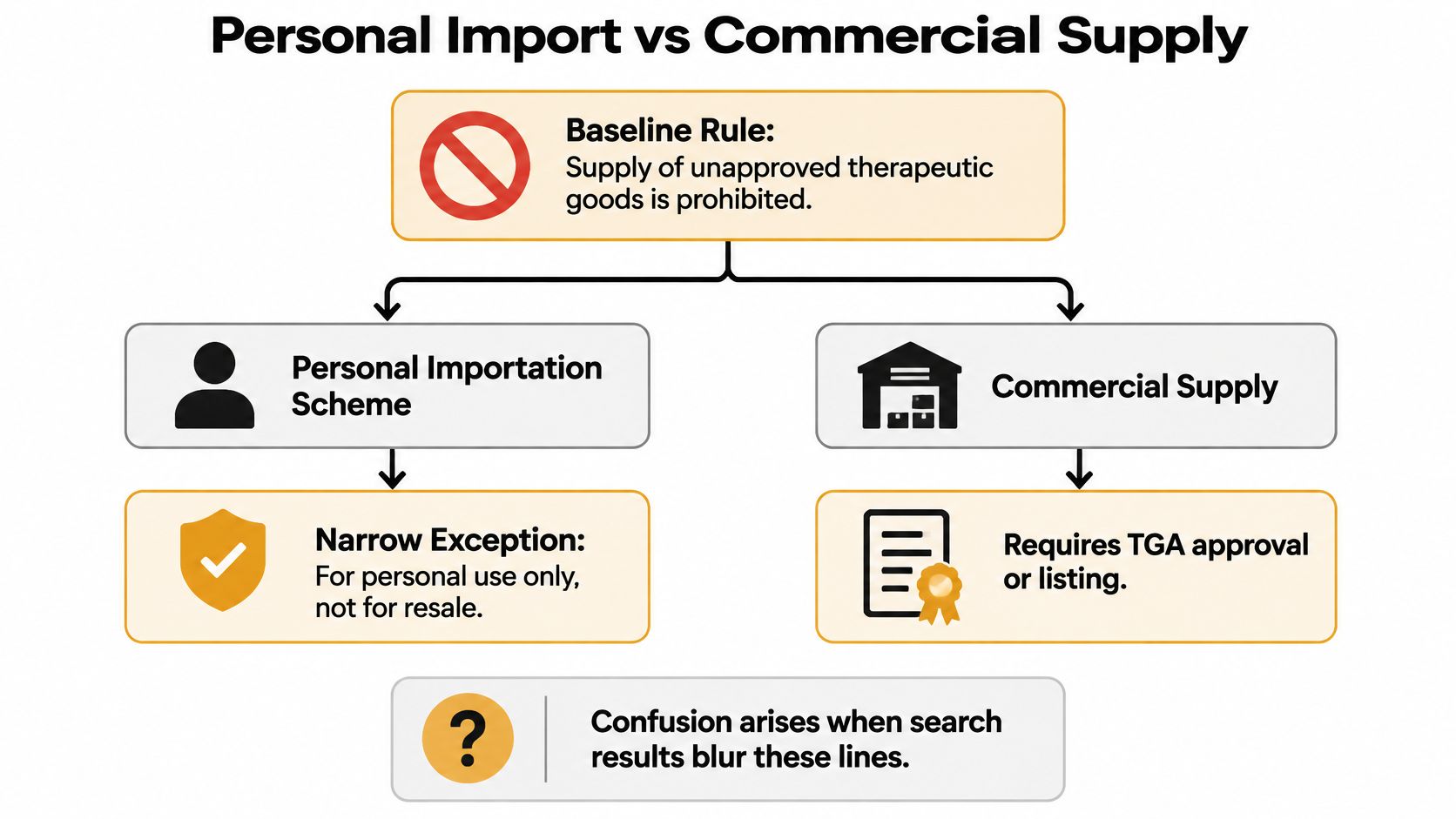
Ask what the route actually allows
Consider two people visiting the same website. One imports a product for themselves under the scheme's conditions. The other places an order, the way they'd buy any retail item. The second transaction is commercial supply, and it carries requirements the seller must satisfy. Asking buyers to assume a personal-import exception covers that sale shifts a legal responsibility onto the person least able to verify it.
A website taking orders from Australian customers should be able to explain the basis for its supply on request.
"Research use only" wording doesn't settle the question either. If a product is promoted or supplied for therapeutic use, a disclaimer alone doesn't establish that the applicable rules have been met. An Australian-facing website or local fulfilment service tells you where parcels ship from. It says nothing about whether the product was imported lawfully or is approved for the claims being made.
The TGA has warned that suspected peptide products have appeared in online markets as powders or injectables in unmarked vials. Its consumer safety alert about importing unapproved peptide products describes concerns including missing information about the active ingredient, concentration or dosing instructions.
For peptides, use a straightforward test: if the seller can't clearly explain the product's status and supply route, don't treat uncertainty as permission to proceed.
The TGA's published guidance on unapproved peptide imports is summarised in this short explainer:
Comparing Approved Unapproved and Compounded Pathways
Two peptide vials can look identical on a screen and sit under completely different legal footing. One may carry an Australian regulatory listing, another may have no TGA assessment behind it at all, and a third may have been prepared for a single named patient. The pathway determines what the product's status means and who answers for its use, so a lower price, a purity claim or faster delivery should never be the reason a route gets chosen.
| Pathway | What the status means | Evidence to request | Key caution |
|---|---|---|---|
| ARTG-listed product | The product has an Australian regulatory listing. | Confirm the exact product and listing details through current TGA information. | Don't assume a similar name or ingredient means the listing covers the product being offered. |
| Unapproved product | The TGA hasn't assessed the product for safety, quality or effectiveness. | Ask about the lawful access route, product identity and batch-specific records. | Access is limited to applicable pathways, and an unapproved product hasn't received TGA assessment. |
| Compounded product | A narrow exemption from ARTG inclusion may apply in specified circumstances. | Clarify who prepared it, for whom, and under what prescription or medical request. | Compounding isn't a general wholesale route for routine commercial supply. |
The TGA explains that a compounded product is generally exempt from ARTG inclusion only when it's prepared for a particular person for application to that person, or compounded in a hospital by an authorised pharmacist in anticipation of patient treatment. That is a narrow set of circumstances. A vendor offering compounded peptides in standardised vial formats to any buyer who checks out online is describing something closer to ordinary retail supply, which is a different thing entirely.
Match the evidence to the route
The evidence worth requesting depends on what the seller claims the product is. For an ARTG-listed product, verify the listing applies to the exact item on offer rather than to something with a similar name. For a product said to reach you through an unapproved pathway, ask who holds responsibility for that route and what product-quality records exist for the specific batch. For a compounded product, ask how the preparation fits the patient-specific or hospital context described above.
This distinction trips people up because availability feels like approval. A comparison of CBD oil access through Australian chemists illustrates the same confusion in a different product category: something sitting within reach of an Australian buyer can still sit outside a lawful supply route. With peptides, make that distinction before weighing concentration claims or delivery convenience.
In practice, ask the seller to name the pathway in writing before payment. A vendor that cannot state whether a product is ARTG-listed, unapproved or compounded has not finished describing what it is selling, and an Australian warehouse or local courier option answers none of those questions.
How Bulk Aussie Peptides Can Help
Bulk Aussie Peptides describes itself as an Australian supplier of research-use-only peptides and laboratory supplies. Its stated offer includes product specifications, batch documentation and certificates of analysis, alongside standardised bulk vial formats and laboratory consumables. Those features may help research buyers organise procurement and review records, but they don't establish that a product is approved for therapeutic use or appropriate for human administration.

For a laboratory buyer, access to specifications and batch records before ordering can make it easier to assess whether documentation is relevant to a research workflow. The business also describes tools such as a peptide concentration calculator, a compound glossary and a COA library. Treat those as procurement and research resources, not as substitutes for independent review of the product, its intended use or any applicable regulatory pathway.
If you're comparing vendors for a legitimate research procurement, Bulk Aussie Peptides' Australian supplier information is one place to examine the business's stated research-only positioning and documentation. Check the actual records for the specific batch, including who produced them and whether the methods and laboratory can be verified. A certificate's presence alone doesn't prove that its conclusions are reliable.
A supplier that offers bulk formats, Australian-based support and domestic order processing may be relevant to a research programme seeking predictable procurement. It isn't automatically the right choice for a therapeutic need, and research-use wording shouldn't be read as a clinical endorsement. Keep the decision tied to the purpose, the route and the evidence.
Checking Supplier Status Labels and Traceability
Start with the exact item, not a broad product category. Write down the product name, active ingredient, intended use and the supply pathway the seller says applies. Then check ARTG information where relevant and ask who is responsible for manufacturing, importing and supplying the product.
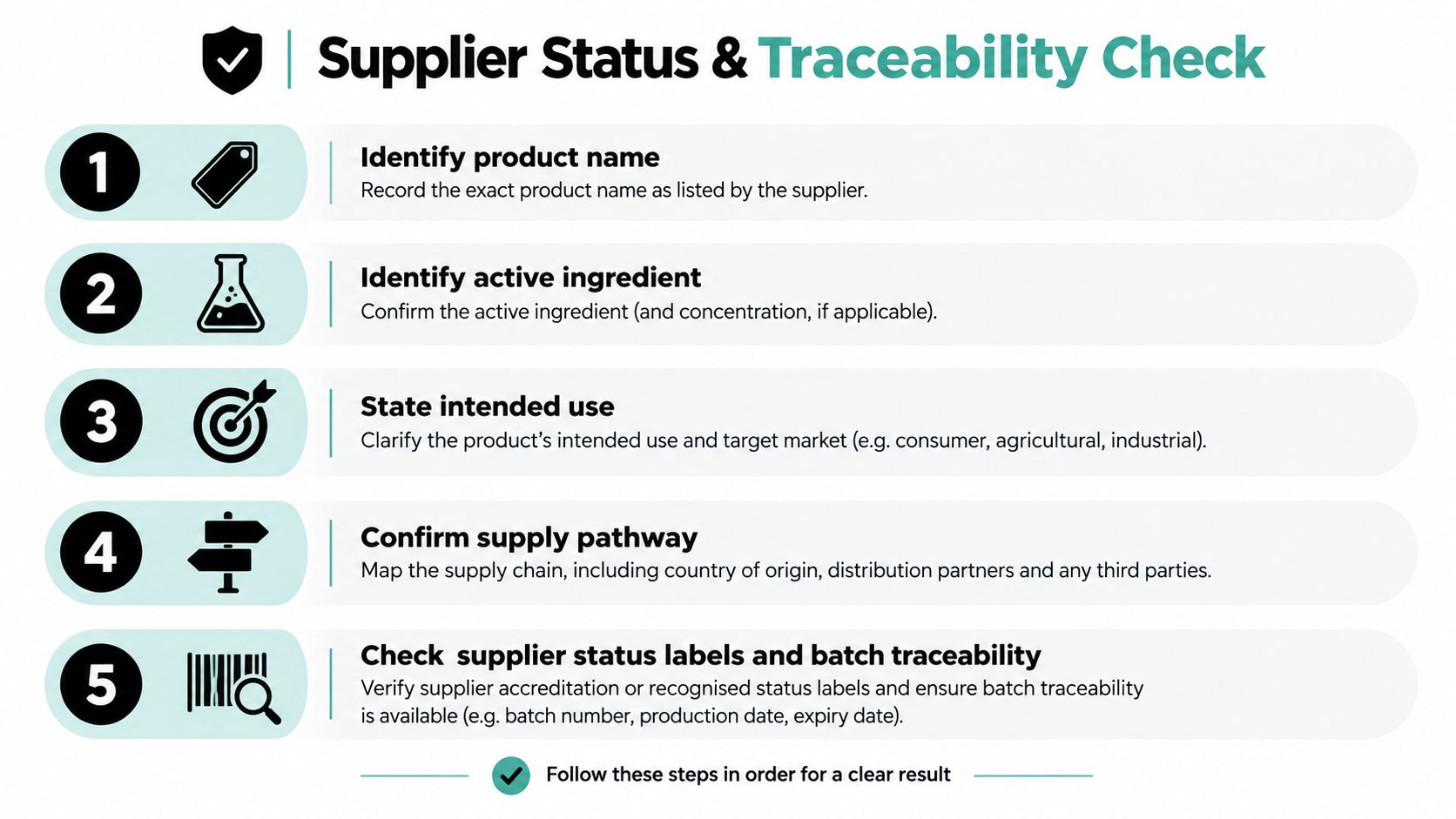
Follow the record from product to batch
Imagine two shoppers. The first sees a vial photograph and a “research use only” disclaimer, but the seller doesn't clearly identify the active ingredient or explain the product's status. The second can review a label, a lot number and batch-specific documents that identify the material and describe the test methods. The second shopper has more information to assess, although documentation still needs scrutiny.
For a procurement review, request records that connect the product to the batch, such as a certificate of analysis, the analytical method, lot number, expiry or retest date, storage conditions and evidence of microbiological controls. The TGA's information for health practitioners about peptide products discusses the quality and safety responsibilities that arise when unapproved products are considered.
A certificate isn't a magic shield. Ask which laboratory performed the work, whether it was independent, and whether the method is suitable for the claim being made. A document that can't be tied to the relevant batch, or whose origin can't be checked, provides less assurance than its title might suggest.
Check what happens after dispatch
Look beyond the product page. Ask how temperature-sensitive goods are handled, who can answer questions after delivery, and whether the supplier can explain the chain from manufacture to import and supply. A vial photograph can't confirm that the delivered item matches the advertised product.
A related guide to CBD gummies in Australia offers another consumer example of why product labels and claims deserve close attention. For peptide procurement, keep the same focus on identification and traceability. If the seller's answers are vague, pause rather than filling in the gaps yourself.
Examples of Warning Signs and Safer Choices
In a composite example, one storefront promises dramatic outcomes, gives little detail about the active ingredient and relies on a research-use-only disclaimer. The buyer can't tell what the vial contains, which batch it belongs to or what pathway the seller says permits its sale. Those gaps don't, by themselves, prove criminal conduct, but they leave basic questions unanswered.

A contrasting composite seller identifies the product and explains its stated regulatory status and supply route. It provides batch documentation that can be reviewed, makes the origin of the records clear and points customers toward an appropriate health professional when the question is clinical. Those practices make the seller easier to assess, but they still don't remove the need to verify the claims.
Weigh evidence, not presentation
An Australian address, a discount code or a social-media testimonial can make a purchase feel reassuring. None establishes a product's ARTG status, the lawfulness of the supply route or the accuracy of its label. The TGA has warned about imported powders and injectables in unmarked vials, including cases where labels lacked the active ingredient's name, concentration or dosing instructions.
Think of supplier checks as a judgment across connected questions:
- Identity: Can you establish what the product is and what the label says it contains?
- Status: Is the stated regulatory pathway clear and relevant to this exact product?
- Traceability: Can the batch be linked to meaningful, reviewable records?
- Accountability: Can you identify who manufactured or imported it and who can answer questions?
One missing document won't automatically settle every legal question. But if the seller can't establish basic identity and traceability, attractive branding or local delivery shouldn't be treated as a substitute.
Making a Professional and Safety Decision
A careful decision separates three questions. First, may this product be supplied through the pathway the seller describes? Second, can its identity and quality be traced to meaningful evidence? Third, is the intended use appropriate for the buyer? A persuasive answer to one doesn't answer the other two.
A product may have documentation yet still be offered through a pathway that needs further checking. Equally, a plausible regulatory explanation doesn't make an undocumented batch suitable for a particular purpose. Connect the exact product to current regulator information, request records tied to the batch, and identify the manufacturer or importer responsible for answering questions.
A purity figure, testimonial or research-only disclaimer can't replace a clear account of product identity, supply route and intended use.
Access pathways exist for certain unapproved therapeutic goods when clinically appropriate. The practitioner remains responsible for assessing product quality and safety in that context, because the TGA hasn't evaluated the unapproved product. That responsibility is a reason to involve the appropriate professional, not a reason for consumers to interpret a research product as a treatment option.
The TGA advises consumers to consult a doctor or other health professional, particularly before using injectable products. Seek professional advice when you're uncertain about intended use, have a health condition or take medicines that could affect the decision. Don't use a supplier's marketing claims to resolve a clinical question.
If the pathway, product identity or clinical purpose remains unclear, pause. A qualified health professional can help address the health question; current TGA information can help you check the regulatory one.
A Safer Rule for Choosing a Peptide Supplier
Treat the cheapest or fastest Australian option as unproven until the paperwork matches the claim. A suburb in the footer, local courier options or a research-use-only line describe marketing and logistics. They say little about lawful status, batch identity or who answers when something goes wrong.
Work from status to evidence: what pathway is being claimed, which exact product is supplied, what records tie to the batch, and which manufacturer or importer stands behind it. If any answer stays vague, the safer choice is delay rather than a hopeful purchase.
Run the pause test: Can the supplier identify the product, explain its status, provide batch-specific evidence and recognise when a question belongs with a qualified health professional? A hesitant, generic or defensive reply is information.
Before acting, check the TGA's current peptide product guidance, since regulatory status can change. If the supplier passes the pause test, document the answers you received; if it does not, the search continues.